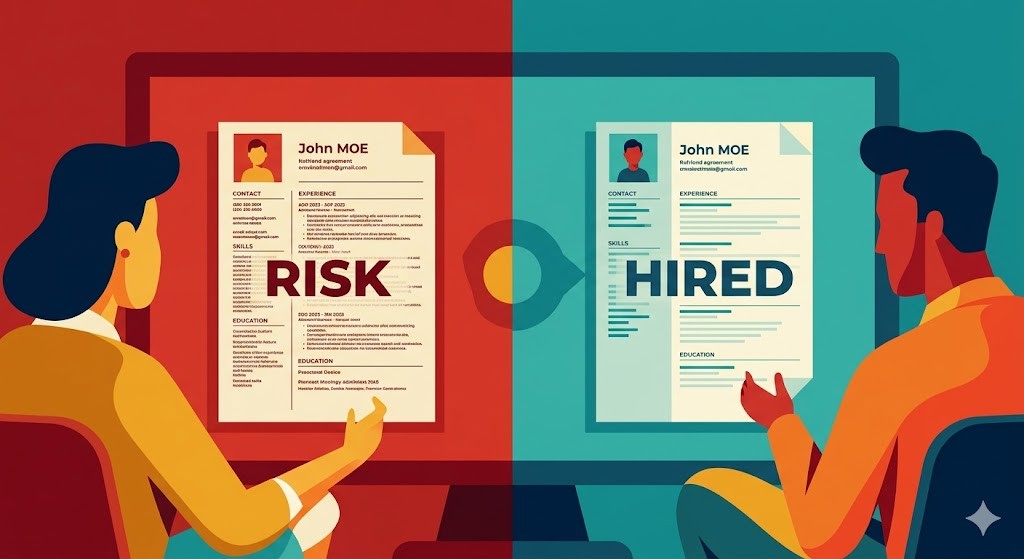


Imagine spending years building an impeccable resume, mastering complex skills, and leading high-impact projects. But the moment you decide to pivot to a new career path, compete in international markets, or apply for a role slightly below your executive level, you hit a concrete wall: "Thank you for your interest, but you are overqualified for this position."
This polite rejection is often just a corporate code word used to mask deep-seated fears and hidden biases within management and human resources (HR). In this article, we dismantle the truth behind the overqualification trap and explore how modern recruitment platforms like Refriend are shifting this paradigm through a human-centric approach.
Anatomy of the Overqualification Trap: What are Managers Afraid of?
Research from LinkedIn Talent Solutions reveals that when a "too strong" resume lands on an HR manager's desk, rational evaluation often takes a backseat to guesswork and cognitive biases. These anxieties typically fall into three categories:
Insecurity Bias: The uncomfortable truth is that corporate hiring isn't always a pure meritocracy. According to reports by Harvard Business Review (HBR), many line managers feel threatened when reviewing candidates who possess more experience than they do. The fear that a highly seasoned newcomer might quickly overshadow them or challenge their authority often pushes your resume straight to the rejection pile.
Flight Risk: According to hiring data from Glassdoor, restarting a recruitment process costs a company an average of 1.5 to 2 times the position's annual salary. Consequently, HR departments assume that highly experienced professionals only take lower-level roles as a temporary financial safety net and will jump ship the moment a better, more aligned offer comes along.
Salary Assumptions: Long before you even get a chance to discuss compensation packages in an interview, organizations make preemptive assumptions. They assume you won't be satisfied with the standard salary bracket for the role and will quickly become demoralized, leading them to reject your resume based entirely on speculation.
The Solution: How to De-Risk Your Resume
If you have chosen to apply for a different or lower-level role, you need to strategically optimize your resume to soothe the hiring manager's anxieties. This process is known as de-risking:
De-escalate Executive Job Titles: If your previous title was "Senior Director" but you are targeting a "Manager" role, consider adjusting it to a more general term like "Team Lead" or "Head of Department" (while remaining honest about your actual duties). Focus the spotlight on your execution rather than grand titles.
Focus on Practical Skills: Instead of listing 20+ years of high-level strategic oversight, narrow your scope to the last 10 to 12 years. Heavily emphasize the specific hard and technical skills required for that exact job description.
Clarify Your "Why" in a Cover Letter: Be entirely transparent about your motivations. For instance, write: “After years in macro-management, I am looking to return to a hands-on, execution-focused role where my true passion lies.” This directly neutralizes the flight risk assumption.
Case Study: How Refriend Breaks Through the Filters
Traditional recruitment systems and rigid Applicant Tracking Systems (ATS) completely lack the ability to understand human intent, passion, and the context behind a career pivot. This is exactly where Refriend changes the game.
At Refriend, hiring is never reduced to just throwing a text file into an automated portal. Every single talent's resume is thoroughly reviewed, audited, and polished by Refriend’s expert evaluation team before it ever reaches an employer. This hands-on curation ensures that potential gaps are filled and resumes are perfectly tailored (de-risked) to meet international standards.
The most compelling proof of this method is the success story of one of Refriend’s seasoned talents. Facing the classic hurdles of being labeled "overqualified" in a highly competitive global market, this professional had their resume fully written, structured, and optimized from scratch by the Refriend team. The newly crafted resume instantly captured the attention of a prominent German employer. Ultimately, this talent bypassed the traditional biases and successfully secured an official job offer to relocate to Hamburg, Germany. This milestone proved that when stellar expertise is paired with precise resume engineering and a trusted referral channel, even the most meticulous European companies drop their biases.
The "overqualification trap" should never discourage you or stall your career progression. The global job market values deep expertise now more than ever; the secret lies entirely in how you package that expertise to bypass a manager's mental filters. By combining premium resume rewriting and optimization services with the unmatched power of a trusted referral network, Refriend helps you turn a perceived risk into your ultimate competitive edge proving that extensive experience isn't a liability, but an invaluable asset to any organization.